How to kill bugs - or how to keep them at bay - has probably been an important question since the dawn of the humankind.
It still is and as going green is becoming more and more powerful trend by the day, no-poison methods are consequently sought after, used and appreciated more than ever.
Video below provides quite a few ways to kill bugs without using any kind of chemical poison.
when you place food on the countertop, cleaned with surface cleaner that claims to kill 99.9 percent of bacteria, those "killing chemicals" can be absorbed in your food
ammonia from the glass cleaners lingers in the air for a long time after it's been used, irritates the respiratory system and pollutes the air we breathe
It's really easy to make your own cleaners with ingredients you might already have in your home. Plus, if you choose to add an essential oil, you can pick your favorite scent and your home will smell pleasantly, matching your own preference instead of smelling of chemicals, found in most commercial cleaners, that are irritating as well as toxic.
• BAKING SODA can be sprinkled to scrub kitchen and bathroom surfaces. It works great as a fabric softener when doing your laundry, and is an effortless silver cleaner (add a sheet of aluminum foil and baking soda in the sink, filled with water and soak your silver pieces until they are clean).
• APPLE CIDER VINEGAR – bubbles when combined with baking soda and is a great drain cleaner: Put some baking soda in the drain, add apple cider vinegar, let bubble for 15 minutes, rinse with hot water. Vinegar diluted with warm water is also a great window cleaner.
• BORAX is an unbeatable and cheap laundry booster and cleaner.
• HYDROGEN PEROXIDE can be used for many purposes, including as disinfectant and whitener.
• LIQUID CASTILLE SOAP and vinegar with water cleans the floors, windows, kitchen, almost anything. Adding an essential oil is optional.
• LEMON is well known for being a natural whitener.
• VODKA in spray bottle works great as fabric refresher for chairs and upholstery.
• ORGANIC ESSENTIAL OILS can be added to many of the above home-made cleaners. Tea tree essential oil and lavender essential oil both have antibacterial properties.
Find out more about the natural cleaning products by clicking on the link below (opens a new window): Green Cleaning Formulas
Homes with green labels in most cases mean energy efficiency, burning less fossil fuels, low-formaldehyde kitchen cabinets, green carpeting, low or VOC-free (volatile organic chemicals) paints and other materials, "green roofing" etc. Most people simply assume that "green" equals "healthy" and never give a second thought to toxicity that might come with their "green home."
It is true that air-tight buildings are energy-efficient but at the same time, the indoor air pollution might be devastating. In other words, proper ventilation is crucial but at the same time pretty much neglected in these new buildings.
All the "green materials", used to build the "green houses" are not necessarily completely nontoxic. At the moment, it is still quite difficult to find out how buyers can tell if a product is both green and healthy but with the rising consciousness, things are moving in the right direction.
For the last few weeks Florida skies have been mostly cloudy, we had lots of rain and thunder storms and lightning. Our grass hardly ever gets a chance to dry out enough so we can mow our lawn.
While all of my plants enjoy the moisture and heat (weeds included) and my banana trees grow faster than ever before (a new leaf every week!), the time to enjoy outdoors is pretty short: early morning and early evening only. Unfortunately, the mosquitoes have the same time scheduled to get around and get something to eat... ;)
Back to lightning thunder storms. There is an excellent post about lightning strikes, with many outstanding images and fascinating lightning facts at: Lightning Strikes Photos.
Enjoy your day, no matter what the weather looks like!
Transcript of a how to video How To Make Your Backyard a Bird Haven:
Quit hogging our own backyard. Make it a haven for your fine feathered friends!
You will need:
undisturbed trees or shrubs, large enough to provide bird shelter
native plants that provide seeds, berries and nectar
water source such as a stream, pond or bird bath
wildflowers
one of more bird feeders
and bird houses matched to your local species
optional: logs
Step 1: Identify which trees and plants already attract your local bird life
Step 2: Add native trees, bushes and flowers that provide seeds, berries or nectar for wild birds.Consult your state horticultural or autobahn society for suggestions - or ask the local nursery. Think twice before getting rid of dead or dying branches and stumps which provide shelter to many bids. Consider adding logs to your landscaping.
Step 3: Include water in your yard. A bird bath, fountain, stream or pond will do the trick.
Step 4: Consider replacing some of our lawn with a wildflower meadow. Even a small patch of wildflowers and tall grass will attract wild birds.
Step 5: Hang bird feeders close to trees so birds can be sheltered and ideally inside of the window so you can enjoy watching them.
Step 6: Build or buy a bird house and then put it up. Check with your local library, fish, wildlife department or autobahn group to see what bird houses suit your local species. Keep your cats inside. It is estimated that house cats cause up to 1oo million bird deaths each year in the U.S.
Step 7: If a bird builds a nest in your yard, leave it in place even after the babies have flown. The birds might return next year.
Did you know?
The study by the National Autobahn Society showed that many common birds, from meadowlarks to field sparrows have recently suffered major population declines.
Probably everyone agrees that deer is a beautiful animal, a pure joy to see when grazing on the edges of woods and pastures and mountain slopes.
Unfortunately, every home owner's feelings of joy can quickly turn into disappointment if this same graceful visitor of one's yard starts munching on the beautiful plants in our carefully planned and maintained backyard.
There are some plants that deer dislike but to protect most of them, we better quickly find out how to keep deer away.
How about an easy, affordable and effective solution, made from natural and food based ingredients, OMRI Listed® and approved for organic gardening by the USDA's National Organic Program?
The video below will show you how easy Deer Off®II is to use, no matter how big or small your yard.
NEW! Deer Off® II Battery-Powered Sprayer, RTU - also repels rabbits and squirrels - working two ways: by taste and odor. If the critter gets past the odor, it'll be repelled by the taste.
This is the first repellent on the market with a battery-powered sprayer, making application easy and hand fatigue a thing of the past - and therefore also very suitable for large lawns.
Its formula is weather-resistant, lasting up to 90 days, should not leave a visible film or residue - and will not change the color of plants or foliage.
Deer Off® II Battery-Powered Sprayer new formulation contains 4 times more of the active ingredient, dries odorless to humans - and is made in the U.S.A.
Janet Marshall is a New Zealand artist specializing in New Zealand native birds, botanical and portrait paintings.
Professionally painting since 1970, she has had her work represented on 13 NZ Post stamps, has written and illustrated ten books for grown-ups and five books for children, including a New Zealand ABC with pictures and poems called K is for Kiwi.
To make your outdoors even more beautiful and natural, arrange your backyard so it becomes bird and butterfly-friendly. It doesn't take much more than choosing the right plants - and watching the video below. And the results just might astonish you...
Besides building materials like carpeting, paints and furniture, manufactured out of plywood -and made with toxic glues - cleaners we use on a daily basis can be huge indoor air pollutants that might cause many health related conditions.
We can easily replace them with more natural products that were traditionally used and work today just as well as they used to for our grandmothers.
Below you find the list of most common indoor air pollutants along with some tips, hints and warnings - to make everyone more aware of what they are bringing into - and using in their homes:
Photo "air pollution comic" courtesy of sustaingreen
avoid using chlorine bleach and ammonia, which are found in most cleaning products and are irritating to the respiratory system
replace aerosol air fresheners and scented candles with essential oils, fragrance sticks and candles, made of bee wax or soy
chemicals that you can smell are a serious warning sign but there are also many silent, just as dangerous ones (like formaldehyde-based chemicals that make fabrics flame-retardant or formaldehyde in glues that hold lots of inexpensive furniture together and formaldehyde in "wrinkle-free” or "easy care" clothes and linens
labels on the cleaners that have any kind of skull or crossbones are best to avoid
other words that call for caution: use only in in well ventilated areas, poisonous, flammable, caustic or toxic
VOCs* can be found in chemical cleaners, paints, vinyl materials and many other products, especially when they’re new. A process known as “degassing” means releasing chemicals into the air and that makes these products a health-risk
* Volatile organic compounds (VOCs) are organic chemical compounds that have high enough vapor pressures under normal conditions to significantly vaporize and enter the atmosphere. (Definition from Wikipedia)
Here's a list of the Top Cancer-Causing Products or The "Dirty Dozen"in the average home, as compiled by the National Cancer Prevention Coalition, which includes:
FOOD
Beef Frankfurters - (eg. Oscar Mayer Foods Corporation)
Whole Milk - (eg. Borden or Lucerne)
COSMETICS AND PERSONAL CARE PRODUCTS
Talcum Powder- (Johnson & Johnson. Inc.)
Cover Girl Replenishing Natural Finish Make Up (Foundation) (Procter & Gamble. Inc.)
Crest Tartar Control Toothpaste - (Procter & Gamble. Inc.)
Alberto VO5 Conditioner (Essence of Neutral Henna) (Alberto-Culver USA. Inc.)
Clairol Nice 'n Easy (Permanent Haircolor) (Clairol. Inc.)
HOUSEHOLD PRODUCTS
Ajax Cleanser (Colgate-Palmolive. Inc.)
Zud Heavy Duty Cleanser (Reckitt & Colman. Inc.)
Lysol Disinfectant Spray (Reckitt & Colman. Inc.)
Zodiac Cat & Dog Flea Collar (Sandoz Agro. Inc).
Ortho Weed-B-Gon Lawn Weed Killer (Monsanto Co.)
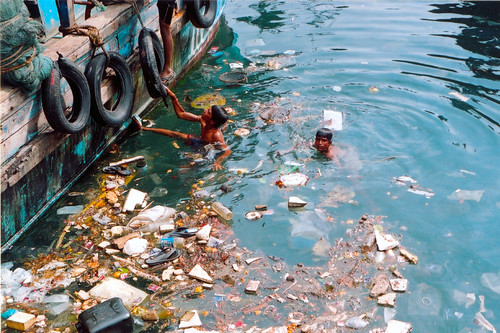
"This was taken during a zoological excursion to study the marine ecosystem at Vizaag and there in the harbour I came across this scenario where few boys are bathing carelessly in the murky waters and the water was polluted beyond imagination.
We have to make these people aware and let them know the minimum standards of life, we have a duty to make them aware about what they think normal in their daily life is far below the standards.
These boys taught about the consequences of water pollution can stop this.God give me the powers to do something for them."
Photo "pollution_at_harbour" and comment above - courtesy of Mandar Sengupta
Especially if you live in an urban area, be aware that there might be lead present in the soil around your house - which makes eating your home-grown veggies risky.
around old homes - flakes of previously used lead paints
near busy roads - remnants of leaded gasoline
around suburban homes, built near apple orchards - lead arsenate used to be a regular pesticide
Your best bet to avoid the pollutants and still enjoy all the benefits of home grown food crops is to build a raised bed, filled with
organic topsoil - or use planters.
In case you're determined to stick with your native earth, have it tested (look under "laboratories" in your phone book or pick up a home test kit which is less reliable but cheaper solution).
When this video was first put online, it circled the globe and was viewed by people in all continents within a matter of 31 minutes!
My today's message is short:
If you or your loved ones are battling disease, please take 5 minutes out of your busy schedule and watch this video here
It might for ever change your life...
Did you know that keeping your plants away from your home's foundations actually very much improves the air flow and at the same time discourages pests?
Instead of creating flower beds around the foundations, place them along the property perimeter and lay pebbles, crushed shell or even pavement all around the house.
Especially if you live in an urban area, be aware that there might be lead present in the soil around your house - which makes eating your home-grown veggies risky.
This kind of pollution is primarily widespread
around old homes - flakes of previously used lead paints
near busy roads - remnants of leaded gasoline
around suburban homes, built near apple orchards - lead arsenate used to be a regular pesticide
Your best bet to avoid the pollutants and still enjoy all the benefits of home grown food crops is to build a raised bed, filled with organic topsoil - or use planters.
In case you're determined to stick with your native earth, have it tested (look under "laboratories" in your phone book or pick up a home test kit which is less reliable but cheaper solution).
Green building products are the ones that are Earth and user-friendly like:
paints and other building materials that are free (or as low as possible) in VOCs (volatile organic chemicals) that will "outgas" (or degas) and cause indoor air pollution (like plywood made with glues with a high formaldehyde content)
local products or the ones that are not shipped long distances - green practice
materials from easily renewable sources (like bamboo)
recycled materials like glass, wood, cork, fabrics, paper, carton and others
by-product materials
low-flow shower heads, faucet aerators and toilets
compact fluorescent bulbs that are 75 percent more energy efficient than traditional light bulbs
Energy Star rated appliances - and more
Seeing the whole picture, building or renovating "green" should benefit the environment, at the same time greatly improve living conditions of the occupants, and last but not least, save lots of money to the homeowner. Built the right way from start, a new home should be durable, healthy, long-lasting, low-maintenance, energy-efficient and environmentally friendly.
Anyone can join the "green building revolution" by choosing better materials in all kinds of home improving projects.
Actually, there's a lot anyone can do for the environment as well as their own wellbeing, no matter if the home you presently live in is green or standard built.
Spending some quiet moments in your yard with plants and observing wildlife is very beneficial, nurturing therapy - and it costs you nothing. If gardening is one of your hobbies than you know what I'm talking about and if you're not, it's never too late to start growing some easy care flowers and soon after enjoy their new growth, blooms and fruits (if they produce any).
However, today I'm not talking about growing just any kind of plants but primarily about the "green landscaping" which includes:
growing native plants that use the least amount of watering once established
growing plants, suitable for xeriscaping because they are also draught-resistent
planting groundcovering plants instead of big areas of lawn (lawns are the biggest consumers of drinking water in U.S. - besides watering in modern agriculture)
planting trees and brushes to prevent the run-off of the rain water
planting deciduous trees so that they cool a home during warmer months, thus reducing the need for air conditioning
planting deciduous bushes around the air conditioning unit to keep the unit cool during the summer
capturing the rain water in the rain barrels (and use that water for watering plants)
In the cities like New York, the "green skyscrapers" started practicing "living roof" which simply means plants on the top of the building. A living roof can capture up to 80 percent of the rain water and has many other benefits. Keeping the streets cooler during the heat of the summer is just one of them.
 Image via Wikipedia


 lingers in the air for a long time after it's been used, irritates the respiratory system and pollutes the air we breathe