Showing posts with label more blooms. Show all posts

Saturday, May 8, 2010

Growing African Violets Under the Full-Spectrum Fluorescent Light Bulb Light

African violet (Saintpaulia ionantha) was discovered by Baron Walter Von Saint Paul in 1892. He found that precious little plant about an hour from Tanga on the nowadays border of Tanzania and Kenya.

AFRICAN VIOLET

Photo African Violet courtesy of Betsy J...


The baron soon took in that the plant was different. So he decided to send some specimens to his father in Germany. He revealed son's find with a botanist at Royal Botanic Garden in Hanover.

Botanist's name was Herman Wendland, and he realized that the plant was new to science. He named the genus after the Saint Paul family "Saintpolia" and coined the species name "ionantha" which in Latin means "violet like."

Since, African Violets quickly made their way to become the most popular blooming houseplant in the world. They are easy to grow by following a few simple rules.


Photo above: African violets (Saintpaulia ionantha) grown from leafs

These are the African violets I grew from four leaves (for the first time ever) with no special care except watering when the soil looked dried out (as on the photo). I'm assuming that full spectrum light would enable anyone to grow plants indoors year-round even though your home has no place with ideal natural light conditions.

The full spectrum light bulbs are no longer very expensive (one of the best prices you find at the website below - click on the link and find out for yourself!), they save energy and have several more benefits which I'll be writing about in my next post.

You Can Grow African Violets: The Official Guide Authorized by the African Violet Society of America, Inc.


***

Wednesday, June 10, 2009

After the rain photos

We had quite a few showers lately. And storms. After each one of them, there came an "after the rain" period, when everything looks clean, the nature more green and the air fresher than ever.

I'm happy to share with you two of my recent photos, both taken in my backyard, during that precious time - right after the rain.


Blooming Adam's needle (Yucca filamentosa) after the rain


Blooming Barbra Streisand pink rose after the rain


***

Friday, March 20, 2009

Daffodil flower

Daffodils have always been one of my favorite spring flowers. My grandmother had them all over her backyard, underneath the grape vines. I'll never forget that sight and the fresh smell of spring ground, bursting with life.


A few years ago I bought some flowering bushes from one of the online nurseries and received a bag of tulip bulbs and a bag of daffodil bulbs as a free gift with that purchase. Obviously, the staff at that nursery didn't care much about the fact that some people live in zone 9 or higher and these bulbs might never get a chance to produce a single bloom.

And that's exactly what happened. I faithfully planted all the bulbs, hoping that somehow, one of these beautiful springs, they will make my day with the blooms that so unmistakably remind me of those care-free days of my childhood.

Nothing happened - for at least four years. The greenery came out every spring - and not a single tulip or daffodil flower.


This last winter was different. A lot more frosts and lower temperatures that usually and a few days ago I noticed a flower bud on one of the daffodil plants in planter next to our driveway. It made me so happy I felt like dancing the dance of joy... :)

This morning my first and only Florida daffodil flower was opened and beautiful. Right away I had to grab a camera and snap some photos. Can you tell I've been playing in Corel with my snapshots for a little while?

***

Tuesday, November 11, 2008

Nasturtium blooms in the kitchen

Although nasturtium blooms look like they are made of parchment paper, fragile and delicate, they are surprisingly durable.

Their taste is spicy and that's where their common name comes from: "Nasus Tortus" (sounds like "tortured nose" to me... :) - means convulsed nose, referring to the faces people made when tasting this surprisingly tangy-flavored plant.

Ways to take advantage of Nasturtium's flavor and decorative color:
  • as garnishes their blossoms look vibrant and last long

  • whole or chopped blooms look great as decoration in creamy soups, salads, butters, cakes, platters, appetizer etc.

  • blooms added to the spinach salad create quite a dramatic effect

  • nasturtium, added to cheese spreads is a winning combo

  • add them to tea sandwiches

  • an idea for stunning look: open-faced cucumber sandwiches on white bread, decorated with orange nasturtium blossoms and violets

  • recipe for a zesty herbal vinegar: use five blossoms per cup of vinegar, place them in decorative bottle, cover them with hot (not boiling!) white wine vinegar for a day, then strain the spent flowers out and add fresh one as decoration

  • stuffed Nasturtium blooms make a sensational, tasty hors d'ouvere: guacamole, chicken salad, egg salad and seasoned cream cheese mixtures all work well for that purpose - as long as their ingredients are really finely chopped to fit in the tiny throat of the flower

  • for tea-time or snack-time treat wrap blossom around a mixture of raisins, walnuts and orange peel in cream cheese

  • Nasturtium buds and green seeds can be pickled and used in place of capers

Nasturtium Crabby Joes Pictures, Images and Photos

Note that nasturtiums will grow in partial shade and produce lush foliage but not too many blooms. In full sun they produce the most blooms and their peppery flavor gets stronger and stronger as the summer sun gets hotter. For a milder taste therefore, choose flowers grown in shade or semi-shade.


***

Sunday, November 9, 2008

Colors of Nasturtium flowers

Nasturtiums and Bachelor's Buttons

Traditional colors of nasturtiums are bright orange and yellow but lately the range of their blossoms are becoming more and more exciting:
  • brilliant vermilion red blooms - "Empress of India"
  • shades of tangerine, soft salmon, deep mahogany and cherry rose - "Whirlybird"
  • the color of a cut white peach with an accent of raspberry in the throat - "Peach Melba"
  • soft cream toned colors in delicate double flowers - "Butter Cream"

Can you make your garden any brighter?


***

Saturday, November 8, 2008

Growing Nasturtiums

Other common names for nasturtium: Common nasturtium, Garden nasturtium, Indian cress

Nasturtium

Photo "Flower Nasturtium" above courtesy of Dave Howell


More reasons for growing Nasturtium:
  • the secret to nasturtium's explosion of blooms is: zero fertilizing
  • historically nasturtium has also been used topically as a remedy for rheumatism
  • about.com about nasturtiums: "Issues treated by Nasturtium include exhaustion, fatigue, lethargy, and depleted immune systems. Nasturtium flower essence is good for anytime you feel under the weather or less that par health wise. It will warm up "colds" and help nurse you back to your normal vitality."
  • snails don't like them
  • established plants are virtually carefree
  • in the garden they self-seed and keep coming back every year
  • they quickly cover the given area, producing decorative foliage and endless amount of brightly-colored blooms
  • the shape of their beautiful leaves is reminiscent of water lily pads, usually flat and round in deep green color, but some are variegated, speckled-like

No wonder some people call nasturtium: every gardener's dream... :)


***

Friday, November 7, 2008

Uses of Nasturtium - Tropaeolum majus

Photo and quoted text below courtesy of pennyeast


With the photography above I found this beautiful description of several uses for Nasturtium plant:

"Nasturtium flowers, leaves and immature seed pods have a tangy taste like water cress, and the colorful flowers really brighten up a green salad. Add some nasturtium flowers to an herb vinegar. The immature pods can be pickled. The mature seeds can be roasted for eating out of hand or used like black pepper.

Nasturtium has long been used in herbal medicine as a disinfectant and wound-healing herb, and as an expectorant to relieve chest conditions. All parts of the plant appear to be antibiotic and an infusion of the leaves can be used to increase resistance to bacterial infections and to clear nasal and bronchial catarrh. The remedy seems to both reduce catarrh formation and stimulate the clearing and coughing up of phlegm.

The leaves are antibacterial, antifungal, antiseptic, aperient, depurative, diuretic, emmenagogue, expectorant, laxative and stimulant. A glycoside found in the plant reacts with water to produce an antibiotic. The plant has antibiotic properties towards aerobic spore forming bacteria. Extracts from the plant have anticancer activity.

The plant is taken internally in the treatment of genito-urinary diseases, respiratory infections, scurvy and poor skin and hair conditions.

Externally it makes an effective antiseptic wash and is used in the treatment of baldness, minor injuries and skin eruptions. Any part of the plant can be used, it is harvested during the growing season and used fresh."


***

Thursday, November 6, 2008

How to plant seeds?

If you are a complete beginner in growing your own flowers, herbs or veggies, then I have a shortcut to your first guaranteed success for you today. :)

Start small and simple, with easy to grow and possibly fast-growing plant. That just might give you so much pleasure that you'll never want to stop planting seeds again...


Above is a photo of about 1 inch tall nasturtium seedling I planted 10 days ago in an outdoor planter

Today my suggestion is to try to plant nasturtium for several reasons:


  • it's really easy to grow
  • its seeds are approximately the size of a dry pea - which makes them a lot easier to plant precisely where you want the plant to be
  • it sprouts in only seven to ten days
  • grows really fast afterwords
  • the whole plant is edible
  • can be grown in the flower bed or in medium-sized pot indoors
  • has beautiful flowers which are also edible and starts blooming as fast as in about 5 to 6 weeks
  • has beautifully shaped leaves, grows in a bushy manner and looks good even without blooms
  • in a flower bed nasturtium will reseed itself and keep coming back every year
  • planted indoors this plant will provide almost instant greenery and thus improve your living space


You might be wondering about a lot of "HOW TOs", you might have loads of questions and - let me assure you - in gardening (like in most other things) - simple is the best.


There's no need to get all stressed out about the seeds and planting and soil and planters. Simply start where you are, with what you have.


How to plant seeds indoors


These are simplified instructions on how to plant one nasturtium seed - in other words - that's how I do it and it's working for me.


There are many conditions that affect every growth and we can't always control them all. Be creative and if one method doesn't work for you, try something a little bit different. Change one factor and observe the results.


  1. any container in the size of at least 4 inches (10 cm) across will do - as long as you poke some drainage holes on the bottom
  2. cover the bottom of the planter with paper coffee filter - it prevents washing the soil out of your pot
  3. fill the pot with store-bought potting mix (garden soil in planters is usually a ticket to failure)
  4. use mister or spray bottle to water - until the water shows up in the saucer underneath the planter
  5. lay a single nasturtium seed on top of the soil in the middle of your chosen planter
  6. cover the seed with 1/2 inch (1 cm) of soil
  7. place to a sunny spot and check on this about-to-happen tiny miracle every day
  8. keep the soil moist - but not soggy


How to plant seeds outdoors

Planting seeds outdoors is pretty much the same. Prepare the soil and then follow instructions from the seed packet regarding spacing, depth and sun requirements. For seedlings hand-watering with watering can is the best because those small plants are quite fragile.


***

Monday, November 3, 2008

Thursday, October 9, 2008

October in Florida gardens


Unique


While most of the country gardeners are getting ready for winter break from their gardening, the Floridians are given another opportunity to spice-up their yards and gardens, to add new colors (or more color) and implement new landscaping ideas by planting some perennials.

We can plant annuals that can only be used in spring time in colder climates. Some best flowers can easily be started from seeds, others can be purchased at the local nursery and some new bulbs will add spring and summer unseen before.

An excellent page on everything that can be planted in October garden in Florida can be found here: Garden ideas: October flowers

Friday, September 19, 2008

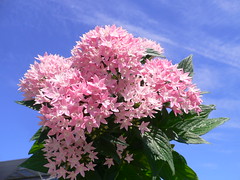
Easy to propagate annuals: Star cluster or "Pentas Lanceolata"


Pink "Pentas Lanceolata"
Originally uploaded by Luigi FDV
These beauties come in pink, lavender pink or red. They vigorously bloom all summer and the butterflies are crazy about them!

They grow 12 to 18 inches tall and can spread 2 to 3 feet wide (given enough space). Pentas perfom equally well in baskets, planters and borders and don't mind Florida's hot sun one bit...

Thursday, September 18, 2008

Old and young - like fall and spring


Two days ago, this was the most stunning sight I caught in my backyard that morning. It was one of those moments when you exclaim out loud "OMG" - even though there's noone around to explain the reaction. It was also one of those moments when you simply have to take a picture...


***

Wednesday, September 17, 2008

Colors of fall

Puffy clouds and the browning needles on the tall longleaf pine tree - the first sights and smells of fall... although, there are still plenty of summery pinks and reds and blues around.
 
  
***

Tuesday, September 16, 2008

Easy to propagate annuals: Angels' Trumpets


Trumpets
Originally uploaded by flower_bee (away)
I remember as it was yesterday when and where I first saw these beauties - although I was still a child.

It was a beautiful summer and my family was taking summer vacations on the beach. Angels' Trumpets were growing on the trellis, all over the place where we had lunch every day. Even back then I thought that these were the most amazing blossoms since I've never before seen anything quite like that .

Those blooms I'll never forget were brilliantly bright orange and fit perfectly on every kid's fingers.

A funny thought just crossed my mind - maybe this sight was an inspiration for Grinch's fingers... :)

Anyway, soon after that my aunt that not only has a green thumb but a magical one (since she successfully grows just about anything she can lay her hands on - or anything with roots) planted one. This tropical plant didn't like colder climate quite as much so the blooms weren't nearly as bountiful as on the beach but it faithfully bloomed every summer and we all enjoyed the unusual flowers and their scent, especially my grandfather.

Now, back to the present.

Angel's trumpet (Brugmansia spp.) grows 4 to 8 feet tall and 3 to 6 feet wide. It likes full sun or at least afternoon sun. Its blooms are sweetly scented and come in shades from white to salmon, soft yellow, peachy pink to orange.

Now is the right time to make cuttings of Angel's trumpet and enjoy even more angelic trumpets and their sweet scent next season.


***

Sunday, September 14, 2008

Easy to propagate annuals: Lantana

Some annuals are easy to propagate. So, instead of tossing them in fall, make cuttings and have plenty of continuously blooming beauties for next year's flower beds and containers.

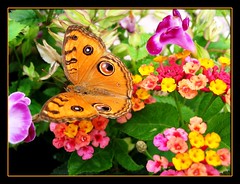
Lantana spp. is one of those beautiful, hardy plants and butterfly magnets that we never want to be without again after we've experienced their vigor and brightly-colored blooms.

They come in gold, yellow, pink, peach, orange and red color and grow 2 to 3 feet tall and 2 to 4 feet wide.


***

Monday, July 14, 2008

New kid on the block

The first thing I've seen this morning when opening my bedroom window - such a pretty blooms, another Florida native plant I don't know the name of.


***

Daria's World - blog about people and things that matter the most

Daria's World - blog about people and things that matter the most
Google