Sunday, June 29, 2008

Fairy Magic

Ever since this Fairy moved into our front yard, this red hibiscus is blooming even more profoundly than before. There's nothing like magic, is there? :)


***

Saturday, June 28, 2008

Eight-petal Hibiscus

Today, my blossoming yellow hibiscus plant looks especially spectacular! :)
Instead of the usual five-petal bloom (which is already beautiful beyond descriptions), today's flower has eight petals and that has never happened before! It looks like double bloom and I Love it!


***

Friday, June 27, 2008

How To Pest-Proof Your Yard Naturally

Some neat ideas to keep certain pests at bay - without using toxic chemicals.


***

Thursday, June 26, 2008

Michael Pollan: The omnivore's next dilemma

From a plant's-eye view by New York Times author Michael Pollan, who wrote the book Omnivore Dilemma - among several others.


***

Saturday, June 14, 2008

Monday, June 9, 2008

Blooming American Beautyberry (Callicarpa americana)

American Beautyberry is another one of Florida natives that's very easy to care for and does well no matter how extreme the weather gets. As all the native plants, it is naturally adapted to the weather conditions and doesn't get damaged easily and no pests will bother it. It grows 4-6 feet tall and wide.

Plant American Beautyberry in full sun to partial shade, in acidic to neutral soil. Its foliage is deciduous. Parts of plants are poisonous in case of ingestion.

Propagation is easy - from seeds or cuttings. It might self-seed.

Both photos: Blooming American Beautyberry after the rain

American Beautyberry looks best when planted amongst other plants/greenery to hide it when it goes dormant during winter time. In late winter (just before the leaves start to flush out) it should be pruned to about 6". This way the bush will grow much fuller and not so tall or leggy.

Unpruned, American Beautyberry bush can get very tall and leggy . Pruning also increases the flowering and fruiting since flowers occur only on the new growth.


In mid spring it starts blooming. Blooms can be in any color from white to pink, from lavender to violet. This bush is very attractive to bees, butterflies and birds, especially mockingbirds.

In fall, American Beautyberry is indescribably attractive with its clusters of purple berries. Mockingbirds sit on the plant and eat berries one at the time. Sometimes even squirrels eat them.

They are edible for human consumption "as is" although they aren't very flavorful, except the ones growing on the river banks with plenty of sunshine. However, they are delicious when made into jelly which especially early Floridians enjoyed a lot.


***

Sunday, June 8, 2008

Blooming Plumeria

Photo: Courtesy of Linda


***

Saturday, June 7, 2008

Blooming Calla Lily


Photo: Courtesy of Linda


***

Friday, June 6, 2008

Thursday, June 5, 2008

Wednesday, June 4, 2008

Like Good-Looking? Here's an Idea!

Basil enjoys the company of rosemary, thyme and parsley ... yum

Photo above: Basil enjoys the company of rosemary, thyme and parsley


Here’s an easy (and good looking!) planting combo:

• Parsley goes great with Greek oregano and chives

• In bed, place oregano in the back (it grows taller)

• In big planter, Greek oregano goes in the center and chives and parsley plants can encircle it


***

Monday, June 2, 2008

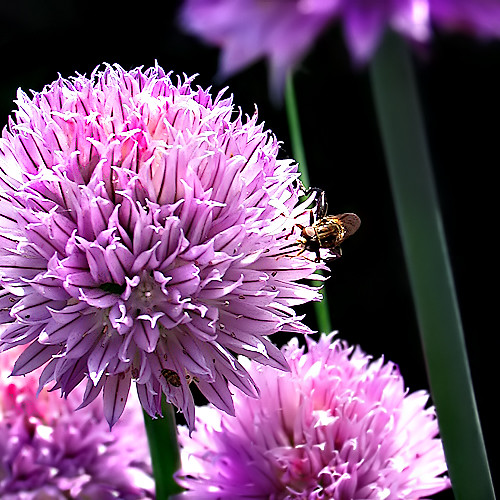
Magic Alliums

Explore*


Like all alliums (onions), chives are also bulb plants with a difference that their bulbs are so tiny that most people never even realize they are there.

Some sources state that chives are native to moist pastures and stream banks of Greece, Sweden, Alps and some parts of northern Britain.

Other sources go as far as 5,000 years ago to the Orient, where chives have been added to the foods first by the Chinese and then by the ancient Greeks.

By the sixteenth century, however, chives were widely present in European herbal gardens and the colonists brought them to America along with other medicinal and kitchen plants, valued at the time.

Garlic chives were believed to have certain magical powers of keeping away disease and evil influences. Bunches of chives were hung in the homes for that purpose.

But even when the magic of garlic chives failed to protect homes, families have, regardless, been rewarded with the decorative virtue of chives - which never fails. Garlic chives dry beautifully!


***

Sunday, June 1, 2008

Growing Parsley

PARSLEY!!

A lot has been written and said about parsley's germination!

That of course doesn't stop parsley from being parsley - taking its own sweet time to germinate just about whenever it pleases...

Anyway, parsley is a biennial and dies away after blooming in early summer of its second year. To keep the steady supply, it is wise to treat it like an annual and sow parsley every year.

Seeds might take weeks to germinate (up to six!) or they may sprout as early as in a week or so.


  • Some sources suggest soaking the seeds in warm water for 24 hours before planting.


  • Others recommend soaking seeds in water, freezing for two days, thawing and then planting.


  • Third ones advise pouring boiling water in drill before planting.


However, I personally know three generations of successful gardeners (my great-grandmother, my grandmother and my mother) who never bothered to do any of the procedures, mentioned above.

They simply planted rows of parsley in the garden when the ground got warm enough in spring. Although, every row of parsley was, as far as I remember, always next to the row of carrots - every year. Also, they were only growing Hamburg parsley (parsnip) becuase its root was a-must-ingredient of the soups or stews.

One thing is for sure, though: I don't remember parsley ever being scarce in their kitchens.


***

Daria's World - blog about people and things that matter the most

Daria's World - blog about people and things that matter the most
Google